
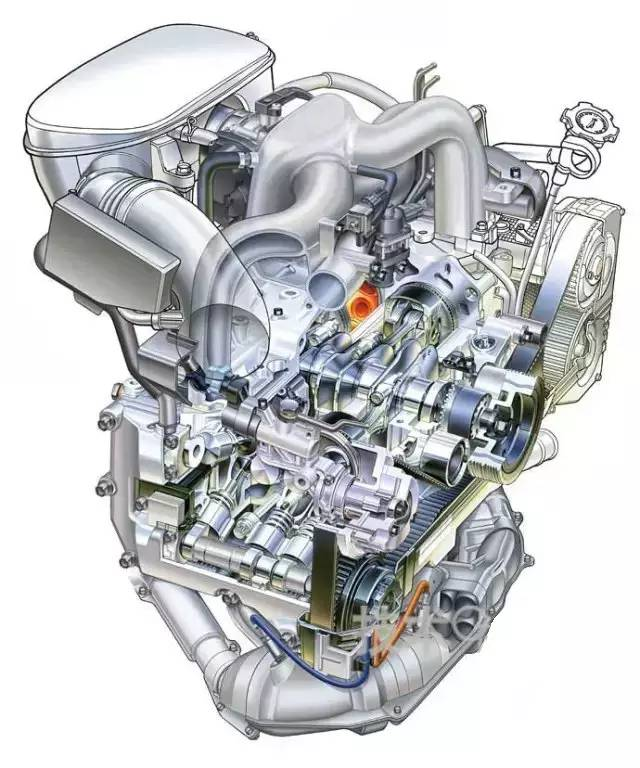
53 Global Automobile Engine Technologies: Detailed explanation of the world's top technologies, a must-read for car fans!
Dec 18, 2024
1. SOHC
(Single Overhead Camshaft Engine) is an engine type divided according to the number of camshaft positions. SOHC means single overhead camshaft engine, which is suitable for 2-valve engines.
2. DOHC (Double Overhead Camshaft Engine) means double overhead camshaft engine, which is suitable for multi-valve engines. Usually, the engine has 2 valves per cylinder. In recent years, 4-valve and 5-valve engines have also appeared. This undoubtedly opens up a way to improve the intake efficiency and power of the engine at high speed. This type of engine is suitable for high-speed engines and can appropriately reduce fuel consumption at high speeds.
3. Turbo
(Turbocharger) is turbocharger, which is abbreviated as T. It is generally marked with 1.8T, 2.8T, etc. on the rear of the car. There are single turbochargers and twin turbochargers. The turbochargers we usually refer to are exhaust gas turbochargers. Generally, the exhaust gas drives the impeller to drive the pump wheel, sending more air into the engine, thereby increasing the power of the engine and reducing the fuel consumption of the engine.
4. VTEC
(Variable Valve Timing and Valve Lift Electronic Control System) VTEC developed by Honda Motor is the world's first valve control system that can simultaneously control the valve opening and closing time and lift. It has now evolved into i-VTEC. The biggest difference between the i-VTEC engine and the ordinary engine is that two different sets of valve drive cams are used for medium and low speeds and high speeds, and they can be automatically switched through the electronic system. In addition, the engine can also automatically change the valve opening time and lift degree according to the driving conditions, that is, change the intake and exhaust volume, so as to achieve the purpose of increasing power and reducing fuel consumption.
5. i-VTEC
(Intelligent Variable Valve Timing and Lift System) i-vtec. system is the abbreviation of Honda's intelligent variable valve timing system. The latest Honda car engines are generally equipped with i-vtec system. Honda's i-vtec system can continuously adjust the valve timing and valve lift. Its working principle is: when the engine switches from low speed to high speed, the electronic computer automatically presses the oil to the small turbine in the intake camshaft drive gear. In this way, under the action of pressure, the small turbine rotates a certain angle relative to the gear housing, so that the camshaft rotates forward or backward within a range of 60 degrees, thereby changing the opening time of the intake valve and achieving the purpose of continuously adjusting the valve timing.
(Continuously Variable Valve Timing System) South Korea's automobile industry has never been known for its advanced technology, so the technology used is mostly borrowed from the experience of Germany, Japan and other countries, and CVVT is developed on the basis of VVT-i and i-VTEC. Take Hyundai's CVVT engine as an example. It can control the opening and closing of the valves at any time according to the actual working conditions of the engine, so that the fuel burns more fully, thereby achieving the purpose of increasing power and reducing fuel consumption. However, CVVT does not control the lift of the valves, that is, this engine only changes the time of intake and exhaust.
7, VVT
(Continuously Variable Valve Timing Engine) This system adjusts the phase of the engine cam through the equipped control and execution system, so that the time of valve opening and closing changes with the change of engine speed, so as to improve the charging efficiency and increase the engine power.
(Intelligent Variable Valve Timing System) VVT-i is Toyota's unique engine technology, which is very mature. In recent years, most of the domestically produced Toyota cars, including the new Vios, are equipped with VVT-i systems. Similar to the VTEC principle of Honda cars, the biggest feature of this system is that it can control the intake camshaft according to the state of the engine, optimize the valve timing by adjusting the camshaft angle, and obtain the best valve timing, thereby increasing torque in all speed ranges and improving fuel economy, thereby effectively improving vehicle performance.9, Dual VVT-i
(Dual Intelligent Variable Valve Timing Engine) Dual VVT-i refers to the intake system and exhaust system that control the engine separately. During rapid acceleration, the VVT-i that controls the intake will advance the intake time and increase the valve lift, while the VVT-i that controls the exhaust will delay the exhaust time. This effect is like a smaller turbocharger, which can effectively increase the engine power. At the same time, due to the increase in the intake volume, the gasoline combustion is also more complete, achieving the purpose of low emissions.
10, D-CVVT
(Dual variable valve timing, variable intake system engine) The basic configuration of Rohens, the V-6 Lambda engine uses dual variable valve timing (D-CVVT) technology on both the intake and exhaust camshafts, and is equipped with a new variable intake system (VIS), which increases the intake volume of the cylinder, thereby improving fuel efficiency. The 3.8-liter V-6 engine has a power of 290 horsepower. Despite its powerful output power, it does not affect its environmental protection and ultra-low emission control (ULEV) characteristics. Among them, the Aisin 6-speed automatic transmission with overdrive gear has contributed greatly. Its smooth shifting performance and wide transmission ratio ensure the powerful power and excellent fuel economy of Rohens.
(Turbo Direct Injection Supercharged Engine) TDI is the abbreviation of Turbo Direct Injection in English, which means turbocharged direct injection (diesel engine). In order to solve the inherent deficiencies of SDI, people have added turbochargers to diesel engines, which greatly increases the intake pressure and generally increases the compression ratio to more than 10. In this way, a large torque can be achieved at a very low speed. In addition, due to more complete combustion, the harmful particle content in the emissions is also greatly reduced. TDI technology allows fuel to be directly injected into the cylinder through a high-pressure injector. Because the piston top is a concave bowl-shaped design, the fuel will form a spiral mixture in the cylinder. The direct injection turbocharged diesel engine (TDI) technology pioneered by the Volkswagen Group equipped with the Bora TDI is very advanced, and it uses a number of advanced technologies, such as the pump injection system and adjustable vane turbocharger, which are all used for the first time in domestic cars. The Bora TDI uses the latest high-pressure fuel injection technology-the pump injection system. This system allows diesel and air to mix more fully and burn more thoroughly; at the same time, it uses an oxidation catalytic reactor to greatly reduce the emissions of CO, HC, and particles, among which CO2 emissions can be reduced by 30% compared with gasoline vehicles of the same displacement. In addition, the use of the EGR system greatly reduces the generation of NOx, and its emission indicators meet the Euro 3 standard. The "TDI logo" of Volkswagen diesel engine is the most successful diesel engine recognized by the world.
12, GDF-P
(diesel engine) The hydraulic timing device of the distribution pump is driven by the timing piston to move the roller frame to adjust the injection timing. The high-pressure chamber of the timing piston is connected to the pump chamber. The pressure of the pump chamber increases with the increase of the speed. The pressure of the piston high-pressure chamber increases with the increase of the speed, and the injection timing is advanced. The Jetta electronic control system connects the electric valve N108 in series between the high and low pressure chambers of the piston. The duty cycle controls the pressure difference between the high and low pressure chambers, and the injection timing changes. The larger the duty cycle, the smaller the pressure difference, and the later the timing. The needle valve lift sensor G80 detects the injection timing and performs closed-loop control on the injection timing. Volkswagen's GDF-P diesel engine is relatively popular.
13, FSI
(stratified combustion engine with direct injection in cylinder) FSI is a new technology in the field of gasoline engines, which means fuel stratified injection. Some are similar to the high-pressure fuel supply technology of diesel engines. It is equipped with a fuel supply system controlled on demand, and then a piston pump is used to provide the required pressure. Finally, the fuel injector injects the fuel directly into the combustion chamber at the most appropriate time. By designing the internal shape of the combustion chamber, there will be a thicker mixture around the spark plug, while other areas are thinner mixtures, ensuring that lean combustion is achieved as much as possible under the condition of smooth ignition. This is also the essence of stratified combustion. FSI has significantly improved power compared to engines of the same level, but fuel consumption can be reduced by about 15%.
14, TFSI
(Turbocharged Fuel Stratified Injection Engine) The T that is more than FSI stands for turbocharger, and the engine itself does add a turbocharger on the basis of the FSI engine. Turbocharging uses the high temperature and high pressure of the exhaust gas to drive the exhaust gas turbine to rotate at high speed, drive the intake turbine to compress the intake air, increase the air density, and at the same time, the computer controls the increase in fuel injection volume, and cooperates with the high-density intake air, so that the engine efficiency can be improved under the condition of unchanged displacement. FAW-Volkswagen and Shanghai Volkswagen call their 1.4TFSI and 1.8TFSI engines 1.4TSI and 1.8TSI respectively, which is extremely irresponsible. At the same time, in order to avoid people's objection to the abbreviation of TFSI as TSI, the manufacturers explained: "Because in the consistent system we generally use three words as the name of the engine's unique technology, this time we abbreviate TFSI as TSI, where T stands for turbocharging and SI stands for direct injection technology." The latest TSI engines of domestic Magotan, Sagitar and other models are actually not the same as the TSI mentioned above. Magotan 1.8TSI and the 1.4TSI engine that will be installed on the Sagitar actually castrate the mechanical supercharging and fuel stratification technology. Of course, this is also a consideration of oil quality and cost issues after localization. Because a mechanical supercharger kit costs at least 15,000 yuan, and it needs to be replaced once every 50,000 kilometers, plus more expensive turbochargers need to be replaced after more than 100,000 kilometers.
15, TSI
(Turbocharger and direct fuel injection engine) The design of TSI (Turbocharger and Stratified Fuel Injection Engine) is very clever. It actually installs a turbocharger and a supercharger into one engine. The T in TSI does not refer to Turbocharger but Twincharger. As mentioned above, turbocharged engines have a power gap at low and high speeds. In order to further improve the efficiency of the engine, a supercharger is added to increase the intake pressure at low speeds. The size of the turbocharger can be larger to make up for the power gap at high speeds, thereby achieving excellent power performance from low to high speeds.
A continuously variable valve phase driving device for an engine of Volkswagen includes a valve with a valve spring, a rocker arm driving the valve to reciprocate, and a rotating cam driving the rocker arm to swing. The cam is a multi-operating cam that can change the valve lift and the opening and closing time. The profile of the multi-operating cam is: one end is a low-speed and low-load cam profile, and the other end is a high-speed and high-load cam profile. There is a smooth transition between the low-speed and low-load cam profile and the high-speed and high-load cam profile. A servo motor that can move the multi-operating cam along its axial direction is connected to the multi-operating cam. Since the profile of the multi-operating cam is continuous and smooth, it can be steplessly adjusted as needed to achieve continuously variable valve phase. In addition, the profile of the multi-operating cam covers various operating conditions of the engine, so the utility model can well meet the variable operating conditions of the engine.
17, AVS
(Variable Valve Lift System) AVS refers to the variable valve lift system, also known as the two-stage variable timing control system. Generally speaking, an engine equipped with such a system will be able to save fuel and energy to a great extent, while increasing horsepower. This technology is widely used in Audi cars.
18, VAD
(Variable Intake Manifold System) Under the control of PCM, the VAD airway can be opened in time when the engine has high power output (opening one more airway is equivalent to increasing the airway diameter), which can maximize the engine's air volume requirements and give full play to the engine's power performance. This technology is widely used in Mazda cars.
19, VIS
(Variable Intake Manifold System) Under the control of PCM, high torque is maintained in the range from low load and low speed to high load and high speed. Working principle: Change the length of the effective intake manifold, effectively control the flow inertia of the intake airflow in the intake duct, make the frequency of the flow pressure wave of the airflow and the frequency of the intake valve match in time under different working conditions, and thus maximize the intake volume of the engine under any working condition. In essence, it uses the principle of medium inertia harmonic supercharging to achieve the maximum intake volume of the engine. When the engine speed is lower than 4400 rpm, VIS does not work, the VIS valve is closed, and the airflow path is longer; when the engine speed is greater than 4400 rpm, VIS works, the VIS valve is open, and the airflow path is shorter; this meets the air volume requirements of different working conditions.
(Variable Vortex Control System) Open the intake manifold to different openings at different water temperatures and speeds to meet the air requirements of various working conditions of the engine. Principle: Under the same working condition, different VTCS valve openings change the flow rate of the airflow entering the engine, forming a vortex. The vortex is what we often call a vortex, which makes the oil and gas mixing of the engine more complete. Especially when the engine is cold started at low temperature and the engine is under low load, the atomization of the mixed gas is not good, the combustion is not complete, and the emission is poor. In order to improve the atomization level of gasoline at low temperature and improve the emission level of the engine, the emission level of Mazda 6 can reach and exceed the Euro III standard. Working process: When the water temperature is lower than about 62 degrees and the engine speed is lower than 3750 rpm, the passage area of the intake pipe is reduced; as the water temperature further increases and the speed further increases, the opening of the VTCS valve is fully opened, and the area of the intake pipe reaches the maximum.
21, ETC
(Electronic Throttle System) As the name implies, it is not controlled by the throttle cable to control the opening of the intake manifold, but is automatically realized by a DC motor through a deceleration mechanism. Function and working process: It has the basic functions of an ordinary throttle, and its function is to open the channel of the intake manifold on the manifold. Different openings are opened under different working conditions. The throttle of a general car is controlled by the throttle cable driven by the foot pedal. However, this cable-controlled throttle has an intake hysteresis phenomenon under special working conditions such as rapid acceleration. That is to say, under special working conditions such as rapid acceleration, the throttle opening signal has been sent out through the throttle position sensor, but the actual air entering the cylinder has not followed up in time, and the throttle is not very stable under airflow disturbance, so the air volume is not stable, and the acceleration is not ideal and unstable. The electronic throttle can respond quickly according to the throttle position signal, and the PCM directly drives the DC motor to respond quickly, and timely open the throttle to the required opening. Moreover, the electronic throttle will not fluctuate due to the disturbance of the air flow under the self-locking effect of its own deceleration mechanism, so as to ensure the stability of the engine's intake volume and speed. Advantages: The electronic control method has a fast response speed and can ensure the supply of the corresponding working conditions in time. The most suitable air volume; the air volume control has high precision and good stability.
22,S-VT
(Variable Valve Timing Control System) We know that the opening and closing time of the intake valve determines the size of the engine's intake volume. The intake volume of a general car is only related to the engine speed. At a certain speed, its intake volume is certain, that is, the opening and closing time of the intake valve is certain. In order to further improve the performance of the engine, the intake control of modern cars comprehensively considers the engine's work needs, and according to the speed, load and other signals, more scientifically controls the opening and closing time of the intake valve to ensure that the engine can reach the maximum intake volume under various working conditions, so as to exert the best performance of the engine. Function: PCM automatically adjusts the opening and closing time of the intake valve under different working conditions to ensure the maximum intake volume of the engine. Principle and working process: It is a duty cycle signal sent by PCM. With the different working conditions of the engine, the pressure control valve of the hydraulic control oil circuit is opened to different degrees, thereby controlling the intake camshaft to change different rotation angles, changing the opening and closing time of the intake valve, and changing the intake volume of the engine. The opening of the throttle valve is controlled by PCM according to various signals according to a certain functional logic to achieve the perfection of intake control.
23,TSCV
(Variable swirl control system) TSCV ensures stable combustion of the engine when it is too cold or too lightly loaded by controlling the swirl in the combustion chamber. The result is better energy output and minimized emissions.
24, TCI
(Exhaust gas turbocharger intercooler technology) Chery 1.9D TCI diesel engine integrates several advanced engine technologies, and has the cleanliness and quietness of gasoline engines and the economy and power of diesel engines. These technologies include: TCI (exhaust gas turbocharger intercooler) technology, which maximizes the engine power and torque without changing the engine exhaust volume; high-pressure common rail direct injection technology, the intake camshaft directly drives the high-pressure oil pump, and the fuel injection is divided into three stages: pre-injection, main injection and post-injection, so as to achieve fuel re-injection during the combustion process, reduce the combustion gas temperature in the cylinder, reduce the generation of NOx, CO and PM are fully oxidized, reduce the generation of CO, PM, etc., and inhibit the generation of carbon smoke; EGR (exhaust gas recirculation) system, which reduces the oxygen content of the mixture in the cylinder, thereby reducing the combustion temperature, improving the combustion process, and inhibiting the generation of NOx; it also adopts structures such as TVD (torsional vibration damper) and dual-mass flywheel. The exhaust emissions of this engine can meet the requirements of Euro IV standards, and the fuel consumption has reached the international advanced level, which can be called a new generation of green power.
25, MVV
(Vertical vortex lean combustion technology engine) BYD's MVV vertical vortex lean combustion technology engine is similar to the general direct injection engine in the cylinder.
26, VICS
(Variable Inertia Intake System Engine) Haima's VICS variable inertia intake system engine. Thus, it has high torque characteristics throughout the entire speed range; the VICS system can ensure high output and high torque throughout the engine speed range from low speed to high speed. This system controls the opening and closing of the valve in the air chamber according to the torque requirements of the engine at different speeds, adjusts the length of the intake manifold path, and improves the optimal engine intake efficiency. After the installation of this system, the engine can increase the torque output by at least 2.2% at low speed.
27, CNG
(Natural Gas Engine) The exhaust gas purification converter of the CNG natural gas engine generally consists of two parts, namely the honeycomb ceramic catalyst and the metal shell. The main principle is: the exhaust gas passes through the honeycomb ceramic catalyst. The active components of the catalyst are mainly rare earth metal oxides, precious metals and transition metals. Under the temperature conditions of 200~300℃, it can fully carry out catalytic reactions and convert harmful components CO, HC, NOX, etc. in the exhaust gas into non-toxic water, carbon dioxide and nitrogen. a. Key technologies The core of the project is CNG engine exhaust purification technology, which belongs to the three-way purification catalyst technology and is the main method for treating CNG engine exhaust. It is currently mainly used in taxis and some models.
28, NICSC-VTC (Variable Intake Control System, Continuously Variable Valve Timing Intelligent Control System) NICS and C-VTC are both Nissan technologies. NICS technology means that the engine air filter is equipped with two intake pipes. The sensor can automatically open and close the valve in the main intake pipe according to the engine speed, thereby improving the intake efficiency, reducing the intake noise at medium and low speeds, and increasing the power output at high speeds. This technology is similar to the "variable intake manifold" commonly used in Audi A6 engines. The full name of C-VTC is Continuously Variable Valve Tinning Contorl (Continuously Variable Valve Timing) is an upgraded version of VTC. This technology is similar to Honda's i-VTEC (an upgraded version of VTEC). C-VTC controls the best time to open and close the valve through a clutch device installed at the front end of the engine camshaft to improve combustion efficiency. C-VTC is a relatively advanced engine technology.
29, Ecotec DVVT
(Dual Variable Valve Timing Engine) VVT refers to variable valve timing. We know that the opening and closing of the intake and exhaust valves of general engines rely on a mechanical timing transmission mechanism, which opens and closes at the corresponding position of the crankshaft angle, which is independent of the engine speed and load. In other words, regardless of the speed, the opening and closing time of the valve corresponds to the rotation position of the crankshaft. Now the pursuit of perfection in engine technology requires that the best performance can be achieved under any load state and speed. Therefore, some people have developed a mechanism that can change the valve timing, which is achieved through hydraulic or electronic control. DVVT and CVVT are both this technology, among which DVVT refers to dual variable valve timing. Its valve opening phase has two moments, which can be opened at position 1 or at position 2, and can be adjusted according to the speed and load. CVVT is continuously variable valve timing. It can be continuously adjusted between two extreme phases in the allowable valve timing phase. It can be said that better control can be achieved, but it must have high control accuracy. The VVT-i promoted by Toyota belongs to CVVT. Currently, Ecotec DVVT is widely used in Buick series.
30, EVIC-III
(Intelligent Dual Valve Variable Intake Control Technology Engine) EVIC-III Intelligent Dual Valve Variable Intake Control Technology is used to improve fuel efficiency ⑴ Variable valve timing technology: that is, it can adjust the valve timing in time with the changes in operating parameters such as engine speed, load, water temperature, etc., and optimize the fixed valve overlap angle. The power and torque output of the engine will be more linear, while taking into account the power output of high and low speeds, so that the engine can achieve the highest efficiency at high and low speeds, reduce emissions and save fuel. ⑵ As an inertial variable intake system, it changes the shape and length of the intake manifold. A long intake pipe is used at low speed to ensure air density and maintain low-speed power output efficiency; a short intake manifold is used at high speed to accelerate the speed of air entering the cylinder, enhance the flow inertia of the intake air flow, and ensure the intake volume at high speed, so as to take into account the performance of the engine at each speed. After installing VIS, the flow inertia and intake efficiency of the engine intake airflow are enhanced, thereby increasing torque and reducing fuel consumption. This technology is currently widely used in Roewe series models.
31, Campro
(Variable camshaft and variable intake manifold engine) Lotus CamPro, an engine jointly developed by Proton and Lotus Engineering in pursuit of high performance, low fuel consumption and low emissions, also because of this engine, Proton officially entered the field of independent research and development, and has world-class technology to produce the next generation of engines. The main purpose is to allow the engine to have better "breathing" to improve the CamPro's unique bottom torque loss problem, and improve the fuel consumption performance of urban driving. At the same time, the ignition system is upgraded to an independent ignition system to obtain more precise ignition control. Improve low-speed power, meet Euro IV standards, fully upgrade ECU, and the engine uses variable camshaft and variable intake manifold technology.
32, MDS
(Variable Displacement Engine) The HEMI engine developed by Chrysler is equipped with an MDS system, which can automatically switch between 4-cylinder and 8-cylinder modes. This technology is most suitable for multi-cylinder engines. It does not affect the acceleration stimulation of large-displacement models, and effectively reduces fuel consumption in traffic jams. For example, after a conventional 8-cylinder engine adopts this technology, it is equivalent to installing two independent 4-cylinder engines. One engine can be run according to driving needs, while the other can be rested.
33, Multi-stage variable intake manifold technology
The length of the intake pipe is controlled by a computer to provide large torque at low speed and large power at high speed.
34, F.I.R.E (Integrated Engine) It is produced in Italy, Brazil, Turkey and other countries, with an annual output of millions of units. It is an economical engine with mature technology and stable performance, and is widely used in various economical cars of Fiat. Take the 188A4000 engine installed in the Fiat Palio sedan as an example. The engine displacement is 1242ml and the compression ratio is 9.5±0.2 1. The engine control system ECU is the IAW 59F multi-point electronic injection system of Magneti Marelli of Italy. The use of electrostatic ignition, sequential injection, non-return oil supply system and dual oxygen sensor technology makes the engine emission level easily exceed the European No. 2 standard and improves the safety of the whole vehicle. This system has the following functions: adjusting the injection time, controlling the ignition advance angle, controlling the radiator electronic fan, controlling and managing the idle speed, controlling cold start compensation, self-diagnosis and self-learning, and has a limp function.
35, VDE
(Variable Displacement Engine) is prepared to be installed on Ford's future cars and trucks to further improve the fuel economy of the car. This engine technology is most suitable for multi-cylinder engines. For example, for a 12-cylinder engine, this technology is equivalent to installing two independent 6-cylinder engines. One engine can be run according to driving needs, while the other is in idle state. In this way, the engine's exhaust volume can be adjusted at any time, thereby reducing fuel consumption.
36, MIVEC
(Intelligent Variable Valve Timing and Lift Control System) The MIVEC mechanism controls the intake camshaft phase through precise instructions from the ECU: the engine's ECU automatically searches for an optimal valve timing corresponding to the engine speed, intake volume, throttle position and cooling water temperature under various driving conditions, and controls the camshaft timing hydraulic control valve, and senses the actual valve timing through the signals of various sensors, and then performs feedback control to compensate for system errors and achieve the optimal valve timing position, thereby effectively improving the power and performance of the car and reducing fuel consumption and exhaust emissions. This technology is widely used in Mitsubishi cars.
37, Double-VANOSValvetronic
(Double camshaft variable valve timing engine) In 1992, BMW launched the Double-VANOS dual camshaft variable valve timing system, which is a world-first technology used in the BMW M3. The advantage of this control system is that the valve timing of the intake and exhaust valves can be adjusted steplessly according to the engine operating state through precise angle control of the camshaft, and it is not affected by the accelerator pedal position and engine speed. In actual driving, this means that sufficient torque can be provided at low engine speeds, while optimal power can be achieved in the high speed range. In addition, the Double-VANOS dual camshaft variable valve timing system can greatly reduce unburned residual gas, thereby improving the engine's idle performance. This technology is used in almost all BMW series.
38, MFI
(Multi-point fuel injection engine) The so-called MFI, originally meant Multiple Fuel Injection, is itself a mature engine technology. The 2.0MFI engine is a masterpiece that has been carefully re-matched based on the German AZM engine, combined with many factors such as Chinese roads, climate, and fuel quality.
39, C-VTC
(Continuously Variable Valve Timing Intelligent Control System) The technology of the C-VTC continuously variable valve timing intelligent control system is basically the same as VVT.
40, VVEL, CVTCS
(Infinitely Variable Intake Lift System and Continuously Variable Intake Timing System) The Infiniti VVEL infinitely variable intake lift system, combined with the CVTCS continuously variable intake timing, also creates the best kinetic energy and combustion efficiency. The device uses continuously variable valve lift (VVEL) technology to optimize efficiency, thereby achieving a balance between power, response, fuel efficiency and emissions. By continuously changing the valve lift and then changing the amount of air in the combustion chamber, the combustion stage is made more powerful and the torque and power are increased. Best of all, because the valves control the intake stroke rather than traditional butterfly valves, the response to throttle input is immediate and fast. VVEL technology improves fuel economy and reduces emissions compared to standard valve lift systems. Precise changes to the ECU help the engine power and torque "expand" gradually, providing a "forming wave" of acceleration rather than delivering peak power.
41, VCM
(Variable Cylinder Management System) Honda's VCM variable cylinder management system technology, the VCM system used in the V6 i-VTEC engine is the first to be used in a non-hybrid Accord model. The new generation of VCM system can switch between three-cylinder, four-cylinder and full six-cylinder working modes, while previously it could only switch between three-cylinder and four-cylinder working modes. The VCM system allows the new Accord to ensure that all six cylinders are put into operation in any situation that requires high power output, such as starting, accelerating or climbing. In medium-speed cruising and low engine load conditions, only one cylinder group, that is, three cylinders, is running, and the rear cylinder group stops working. During medium acceleration, high-speed cruising and gentle slope driving, the engine will run with four cylinders, that is, the left and middle cylinders of the front cylinder group work normally, and the right and middle cylinders of the rear cylinder group work normally. The new 3.5-liter V6 engine uses Honda's most advanced VCM variable cylinder management technology. The VCM system can automatically switch between 3-cylinder, 4-cylinder and full 6-cylinder working modes. When the vehicle starts, accelerates or climbs a slope, all 6 cylinders are put into operation. When the vehicle is in a medium-speed cruise and low engine load condition, the system only operates one cylinder group, that is, 3 cylinders. When the vehicle is in a medium-speed acceleration, high-speed cruise and driving on a gentle slope, the engine will use 4 cylinders to operate, thus greatly reducing fuel consumption. This 3.5L V6 is not only the most powerful Honda engine to date, but also has a fuel consumption that is 7% lower than the previous generation Accord 3.0 model.
42. Inverted engine.
The Focus's Duratec-HE inverted aluminum alloy engine is made of all-aluminum alloy casting and inverted design. It has a maximum power of 104 kW and a maximum torque of 180 N·m (2.0L engine) [1] . It is equipped with a variable inertia intake system (VIS) and a long intake manifold made of plastic steel. It has the advantages of agile acceleration, smooth operation, high-efficiency intake effect, low noise and low fuel consumption.
43. Horizontally opposed engine.
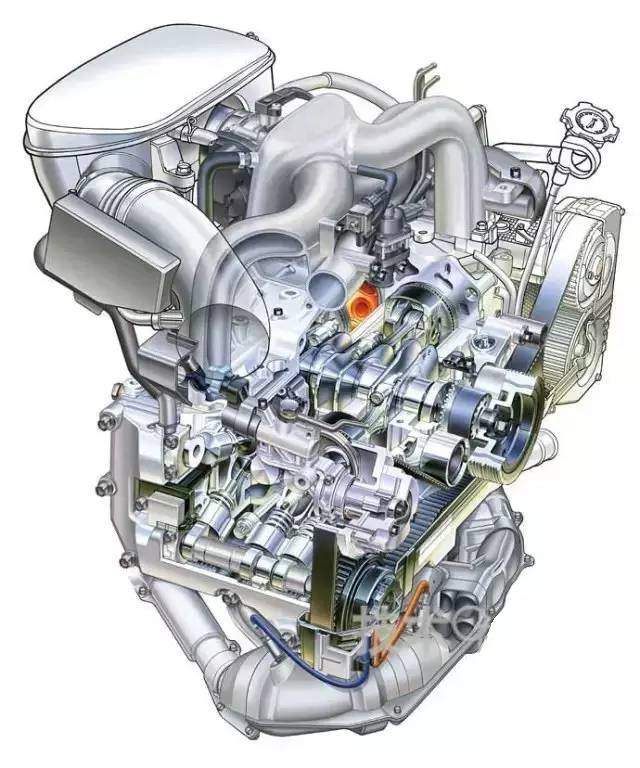
The engine pistons are evenly distributed on both sides of the crankshaft and move left and right in the horizontal direction. This reduces the overall height of the engine, shortens the length, and lowers the center of gravity of the vehicle, making the vehicle run more smoothly. The engine is installed on the center line of the vehicle. The torques generated by the pistons on both sides offset each other, greatly reducing the vibration of the vehicle during driving, greatly increasing the engine speed and reducing noise.
44. i-DSI.
(Lean combustion technology) i-DSI is dual spark plug ignition, which can improve combustion efficiency. By increasing the air-fuel ratio of the mixture in the engine, the mixture is allowed to burn when the air-fuel ratio is greater than the theoretical air-fuel ratio. The relatively rare out-of-cylinder lean combustion technology is not as advanced as direct injection, but it is cheaper than direct injection engines.
45, GDI
(Gasoline direct injection engine) Mitsubishi's GDI engine uses lean combustion technology to reduce fuel consumption by 20%-35%, reduce carbon dioxide emissions by 20%, and output power is 10% higher than ordinary engines of the same displacement. Direct injection technology is a branch of lean combustion technology. The biggest difference from ordinary engines lies in its direct injection system. In fact, direct injection is not a new technology. Many years ago, many diesel engines adopted this technology design, but it has only been used in gasoline engines for a few years. There are two major advantages of direct injection technology: 1. The engine can directly inject gasoline into the high-pressure combustion chamber before the spark plug ignites, and at the same time, under the precise control of the ECU, the mixed gas is burned in layers. This technology can make the mixture near the spark plug relatively rich and the mixture far from the spark plug relatively thin, so as to achieve "lean" ignition and stratified combustion more effectively. 2. Since the gasoline is directly injected into the cylinder, compared with the transmission cylinder injection, the mixed gas does not need to pass through the throttle valve, so the air resistance of the throttle valve to the mixed gas can be reduced.
46, MPi
(External injection engine) The fuel is injected into the intake pipe. In order to allow the gasoline to have enough time to mix with the air after being injected into the intake pipe, the injector needs to be separated from the valve by a certain distance. After the gasoline and air are fully mixed in this space, they are introduced into the cylinder for combustion. For this traditional design, if the gasoline is injected directly into the cylinder, it is bound to cause insufficient time for the air and gasoline to mix. This unmixed gas obviously cannot meet the engine ignition requirements. The first thing that the direct injection engine needs to solve is this problem.
47, IDE
(Direct Injection Engine) IDE still uses a lean mixture of air and fuel, but at the same time increases the amount of exhaust gas recirculation through the EGR valve. EGR is the abbreviation of Exhaust Gas Recirculation, which means exhaust gas recirculation in Chinese. This technology can reduce fuel consumption and effectively reduce combustion temperature - this is the root cause of its effective solution to the emission problem of GDI engines. As we all know, air is mainly composed of nitrogen, oxygen, carbon dioxide and some other inert gases. Among them, nitrogen, which accounts for the largest proportion, is a very stable gas and is usually difficult to be directly oxidized by oxygen. However, if it is in a high temperature and high pressure environment, the usually very stable nitrogen can easily react with oxygen to produce very harmful nitrogen oxides. Ordinary engines, including the GDI engines mentioned above, have a high temperature and high pressure environment in the cylinder when they are working normally. In this way, the mixed gas of air and fuel can easily generate nitrogen oxides after combustion. This is particularly problematic for engines with direct injection. Since the compression ratio of direct injection engines is usually designed to be relatively high, the cylinder pressure is greater than that of ordinary engines, making it easier to produce nitrogen oxides. We all know that diesel engines usually emit much more nitrogen oxides than gasoline engines, mainly because of the high compression ratio of diesel engines. In the case of being unable to reduce pressure (because high compression ratio is a necessary means to improve engine efficiency), the only way to reduce nitrogen oxide emissions is to reduce the combustion temperature in the cylinder. The EGR exhaust gas recirculation system of the IDE engine is to reduce the temperature of the combustion chamber by reintroducing part of the exhaust gas discharged from the cylinder into the intake pipe to mix with fresh air and fuel for combustion. We know that the exhaust gas that has been burned cannot be burned again. After these exhaust gases are introduced into the cylinder, they will occupy part of the effective volume in the cylinder. This effect is equivalent to reducing the displacement of the engine, which can naturally effectively reduce the combustion temperature and the exhaust gas emissions.
48, i-VCT (intake variable timing cam engine) i-VCT, also known as the variable intake cam timing system, can use the engine to output more than 90% of the torque in the speed range of 2000rpm to 5000rpm, ensuring the continuity of engine performance. VVT-i, variable valve timing system, focuses on the characteristics at low speed, but in fact, Toyota's VVT-i does not have rich torque below 2000rpm, and low-speed high-gear driving feels more torque-deficient. This is because the operation of VVT-i cannot cover the range of low speeds and can only rely on the coordination of gears. Toyota's gears are too focused on driving smoothly, which leads to the lack of passion in the driving of the integrated car. But the momentum at the start-up acceleration stage is good, which is also specially adjusted to meet the characteristics of urban driving. The DURATEC-HE2.3 inline four-cylinder 16-valve double overhead camshaft aluminum alloy engine equipped in the new third-generation Ford Mondeo adopts advanced technologies such as i-VCT variable intake cam timing, and its emissions meet Euro IV standards. Compared with products of the same level, it is more fuel-efficient at low speeds and has more abundant power output at high speeds.
49, SIDI
(Intelligent Direct Injection Engine) Cadillac SIDI engine integrates intelligent direct injection, D-VVT electronic variable dual valve timing and the latest ECM engine management module. The structure of SIDI dual-mode direct injection engine has been greatly adjusted. Compared with the original injection into the intake manifold, SIDI engine replaces the multi-point injection fuel supply system with a variable valve direct injection system. This is to implant the fuel injector into the cylinder, spray the fuel into the cylinder through high pressure, and ignite the mixed air, so as to achieve lean combustion in the cylinder, thereby improving the engine efficiency. At the same time, it also has excellent fuel economy and lower exhaust emissions. In addition, direct injection technology allows a higher compression ratio (SIDI's compression ratio is as high as 11.1:1), which can greatly reduce the knock in the cylinder and reduce the vibration of the engine. All of the above advantages can make the engine life much longer than ordinary electronic injection engines. Based on the above characteristics, the SIDI dual-mode direct injection engine can increase the maximum power by about 15% and the maximum torque by about 8% compared with the multi-point injection fuel supply engine of the same displacement, and can also achieve more than 3% fuel efficiency.
50, ETCS-i+ACIS
(Intelligent timing variable valve control and intelligent electronic throttle control system) Lexus SC430 is equipped with a 4.3-liter 32-valve V8 engine, equipped with an intelligent timing variable valve control system (VVT-i) and an intelligent electronic throttle control system (ETCS-i), with endless power. The most admired feature of the engine is the special design of the convertible body.
51, Twin turbocharger engine
Mercedes-Benz's twin turbocharging is one of the turbocharging methods. In view of the turbo hysteresis phenomenon of exhaust gas turbocharging, two turbines, one large and one small, are connected in series or two identical turbines are connected in parallel. When the engine is at low speed, less exhaust can drive the turbine to rotate at high speed to generate sufficient intake pressure and reduce the turbo hysteresis effect. Common turbochargers are all single turbochargers, which are divided into mechanical turbochargers, exhaust gas turbochargers and compound turbochargers. Mechanical turbochargers are engines that directly drive the turbine. The advantage is that there is no turbo lag, but the disadvantage is that some power is lost and the boost value is low. Exhaust gas turbochargers rely on the residual kinetic energy of the engine exhaust to drive the turbine to rotate. The advantages are that the turbine speed is high and the boost value is large, which significantly improves the power. The disadvantage is that there is a turbo lag phenomenon, that is, the engine has a low exhaust kinetic energy at a low speed (generally below 1500-1800 rpm), and it cannot drive the turbine to rotate at a high speed to increase the intake pressure. At this time, the engine power is equivalent to naturally aspirated. When the speed increases, the turbocharger takes effect and the power will suddenly increase. Series and parallel connection of twin turbochargers On twin-turbocharged cars, you will see two sets of turbines connected in series or in parallel. Parallel means that each set of turbines is responsible for the work of half of the cylinders of the engine, and each set of turbines is of the same specification. For example, Porsche 911 turbo, Skyline GT-R's RB26DETT, Supra's 2JZ-GTE and BMW's new 3.0 twin turbocharger are all outstanding representatives of parallel turbochargers. Their advantages are fast boost response and reduced pipeline complexity. Series turbochargers are usually composed of two sets of turbines, one large and one small, in series. At low speeds, the small turbine with faster response is pushed to make the low-speed torque rich. At high speeds, the large turbine intervenes to provide sufficient intake volume and increase power output. The 13B-REW engine of the RX-7 is a good example of series turbochargers. Common turbochargers are single turbochargers, which are divided into mechanical turbochargers, exhaust gas turbochargers and compound turbochargers.
52, VIM
(Variable Intake and Exhaust Manifold Technology Engine) Lamborghini Lamborghini VIM Variable Intake and Exhaust Manifold Technology Engine Since the mid-1990s, variable intake manifold technology has become increasingly popular in automobiles. This technology can improve the torque output of the engine at low and medium speeds, has no bad effect on fuel economy and high-speed power, and can thus improve the adaptability of the engine. The usual fixed intake manifold can only be designed with the most optimized geometry according to the specific requirements of the engine, or according to the requirements at high and low speeds, or a compromise method can be adopted, but no matter which design is used, it cannot take into account the requirements at different speeds. Variable intake manifold technology can be divided into two or more stages to adapt to different engine speeds. Variable intake manifold technology is somewhat similar to variable valve timing technology, but variable intake manifold technology focuses more on improving torque output at low speeds (the effect of improving power output at high speeds is not very obvious), so this technology is widely used in ordinary civilian cars. However, this is not absolute. Since it can provide better engine responsiveness, this technology is gradually being adopted in sports cars, such as Ferrari's 360 and 575. Compared with variable valve timing technology, variable intake manifold technology is cheaper - it only requires some simple solenoid valves and the design of the intake pipe shape to achieve it; while variable valve timing technology requires a complex and precise hydraulic system to drive it, and if the valve stroke is changed, some special camshafts are also required. At present, there are two types of variable intake manifold technologies: variable intake manifold length and variable intake resonance, both of which are achieved through the geometric design of the intake manifold. Let's discuss these two technologies separately. Variable intake manifold length Variable intake manifold length is a technology widely used in ordinary civilian cars. Most of the intake manifold lengths are designed to be adjustable in two sections - a long intake manifold is used at low speeds, and a short intake manifold is used at high speeds. Why is it designed as a short intake manifold at high speeds? Because it can make the intake smoother, this should be easy to understand; but why do we need a long intake manifold at low speeds? Won't it increase the intake resistance? Because the frequency of engine intake is also low at low engine speeds, a long intake manifold can gather more air, so it is very suitable for matching the intake demand of the engine at low speeds, thereby improving the torque output. In addition, a long intake manifold can also reduce the air flow rate, so that air and fuel can be better mixed, combustion is more complete, and greater torque output can be generated. In order to better adapt to the intake needs of different speeds, some systems adopt a design of three-stage variable intake manifold length, such as the V8 engine. Each row of cylinders has three adjustable intake manifolds, with a total of 24 intake manifolds. In fact, Audi did not separate the intake manifold. It arranged a spiral intake manifold around the central rotor. Different intake manifold lengths can be obtained when the rotor rotates to different positions. The entire system is arranged on the inner side of the V-shaped angle of the V-type engine. Lamborghini also has a more upscale Reventon with a three-stage variable geometry intake manifold and an engine with variable formal intake and exhaust camshaft technology.
53, Hybrid power system
Hybrid power is generally referred to as hybrid power, that is, a mixture of fuel (gasoline, diesel, etc.) and electricity. Hybrid vehicles are vehicles that use electric motors as auxiliary power to drive the engine. Hybrid vehicles have high fuel economy and excellent driving performance. The engine of a hybrid vehicle uses fuel, and when starting and accelerating, it can reduce fuel consumption due to the assistance of the electric motor. Simply put, compared with cars of the same size, the fuel cost is lower. Moreover, the electric motor that assists the engine can generate powerful power at the moment of starting, so the owner can enjoy a stronger start and acceleration. At the same time, a higher level of fuel economy can be achieved. There are currently three main types of hybrid vehicles: one is the "parallel mode" with the engine as the main power and the electric motor as the auxiliary power. (Parallel Hybrid) This method is mainly driven by the engine, and uses the characteristics of the electric motor to generate strong power when restarting. When the engine fuel consumption is high, such as when the car starts and accelerates, the electric motor is used to assist the drive to reduce the engine's fuel consumption. The structure of this method is relatively simple, and only requires the addition of an electric motor and a battery to the car. Another method is the "series and parallel method" in which the car is driven only by the electric motor at low speeds, and the engine and electric motor cooperate to drive when the speed increases. (Fuel Cell) It is driven only by the electric motor at starting and low speeds. When the speed increases, the engine and electric motor share the power efficiently. This method requires a power sharing device and a generator, so the structure is complex. There is also a "series method" of electric vehicles that are driven only by electric motors. (Series Hybrid) The engine is only used as a power source, and the car is driven only by the electric motor. The drive system is only an electric motor, but because it also needs to install a fuel engine, it is also a type of hybrid vehicle.